
Finance fundamentals

Finance has maybe fifteen ideas in it. Everything else is those fifteen applied to a specific situation, dressed in vocabulary that exists partly to keep the conversation in the room.
This page is the fifteen. Time value of money, what the three statements say, why profit and cash are different numbers, the ratios worth calculating, how a budget gets built, what a discount rate is doing, and when to take debt instead of selling equity.
You will not finish it and be a CFO. You will finish it able to follow a conversation you are currently nodding through, which is a real and specific thing to gain.
If you want the structured version
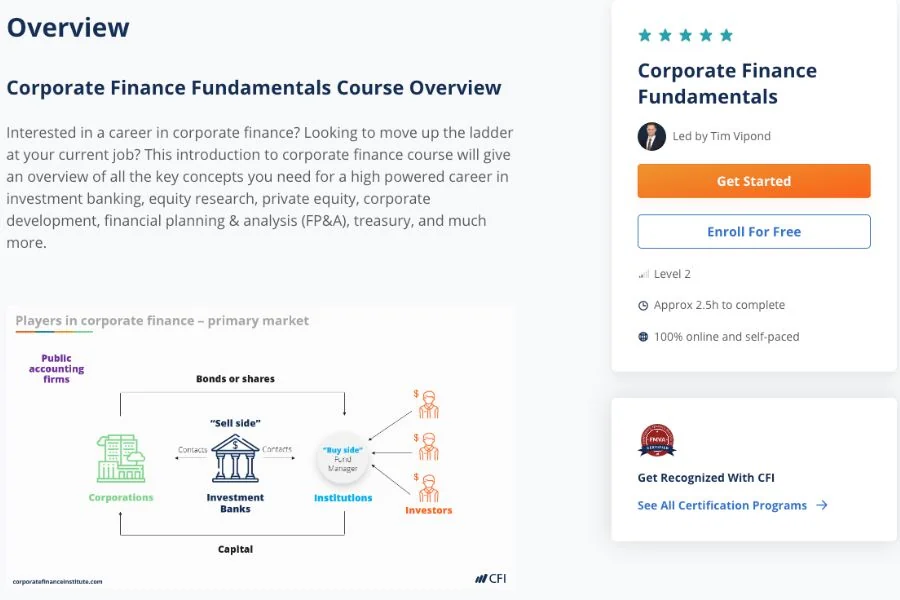
Everything below is free and reading it is enough. If you would rather work through it in order with exercises and something to put on a CV, the Corporate Finance Institute is the one I point people at, and the pricing is worth knowing before you click.
| Plan | List price | What you get |
|---|---|---|
| Free account | $0 | Intro videos from most courses, the whole Careers in Finance course, and the template and cheat-sheet library |
| Self-Study | $497 a year | Every course and certification, at your own pace |
| Full-Immersion | $847 a year | The above plus an AI tutor and guided support |
Prices checked against CFI’s own pricing page on 31 August 2026. They run discounts often enough that you should never pay list without checking, and a promotion was live the day I looked, but promo prices belong in your browser rather than in an article that will still be here next year.
Start with the free account. The template library alone is worth the signup, and it tells you fairly quickly whether the teaching style works for you before you spend anything. What I recommend, and why, if you want the longer answer on training.
Affiliate disclosure: some links on this page pay F9 Finance a commission at no cost to you. That has not changed what is written above, and the free tier is the one I lead with precisely because it pays nothing.
Chapter 1: basics of Finance

Finance has its own language, filled with unique terms and concepts. Grasping this language is the first step. From assets to liabilities, from revenue to expenses, these terms form the basic vocabulary of finance. When you understand these terms, you can read financial statements, discussions, and literature, which will aid in making informed decisions.
The concept of Time Value of Money
The notion that a specific amount of money today is worth more than the same amount in the future is known as the time value of money. This principle is central to finance and impacts many areas, such as investing, lending, and saving. The future value of money is influenced by factors including inflation, risk, and opportunity cost, meaning the potential earnings missed when one option is chosen over another.

An introduction to financial statements
Financial statements are the report cards of a business’s financial health. There are three primary types of financial statements: the balance sheet, the income statement, and the cash flow statement.
The balance sheet shows what a company owns (assets) and what it owes (liabilities), with the difference being equity.
The income statement reflects a company’s profitability over a period, indicating revenues, expenses, and net income or loss.
The cash flow statement shows how cash enters and leaves the company, split into operations, investing, and financing activities.
Learning how to analyze financial statements is an essential part of financial literacy. A company’s financial statements are like its fingerprints, providing insight into its performance and the state of its finances. By studying these documents, you can learn how to interpret a business’s financial health and make better decisions related to your investments.
Profit vs. Cash flow
Profit and cash flow are two key metrics for a business, often mistaken as identical. However, they measure different things.
Profit is an accounting concept that indicates the surplus after all costs are subtracted from revenue.
Cash flow, on the other hand, shows the amount of cash moving in and out of a business.
A company might be profitable on paper but still face cash flow problems if its expenses are due before its revenues materialize. Understanding this difference is the one that matters for successful financial management.
Chapter 2: financial analysis

Financial analysis is the backbone of decision making in business. It offers quantitative insights into a company’s performance, thereby aiding strategic planning and risk management. Financial analysis enables stakeholders to assess a company’s profitability, liquidity, and solvency.
By analyzing financial statements and using financial ratios, decision-makers can identify trends, compare performance with competitors, and evaluate the impact of business strategies. This process helps in making informed decisions about investment, budget allocation, and potential partnerships or mergers.
Understanding financial ratios
Financial ratios are incredibly valuable tools for understanding a company’s financial health. They are derived from figures on financial statements and used to analyze a company’s performance.
Some of the most commonly used ratios include the profitability ratios like return on assets (ROA) and return on equity (ROE), liquidity ratios such as current ratio and quick ratio, and efficiency ratios like asset turnover ratio and inventory turnover ratio.
Each provides a different perspective on the company’s financial situation and performance. Understanding how to calculate and interpret these ratios is key to making well-informed business decisions.
Case study, analyzing liquidity ratios
Consider a hypothetical corporation, F9 Industries, Inc. F9 Industries, Inc. has consistently increased its ROA and ROE, indicating heightened profitability. However, a closer look at the liquidity ratios reveals that the company’s current ratio has decreased, suggesting a potential liquidity problem.
This situation implies that while F9 Industries, Inc. is making profits, they could struggle to meet their short-term liabilities if immediate action isn’t taken. This real-world scenario illustrates the importance of comprehensive financial analysis. Without considering all relevant financial ratios, the company’s stakeholders might have missed an impending liquidity crisis, underscoring the role of financial analysis in prudent decision-making.
The finance fundamentals sheet
The AI library for finance teams
The fifteen ideas on one page, the ratios worth calculating with what each one tells you, and the checks to run on anything a model explains to you. Free, and it lands in your inbox in about a minute.
Chapter 3: the art of budgeting and forecasting

Understanding financial ratios is just the beginning. The next the one that matters step in mastering financial management is learning the art of budgeting and forecasting. Both these basic fundamentals of financial decision-making allow businesses to plan ahead, allocate resources effectively, and make informed decisions to drive sustainable growth.
The fundamentals of budgeting
Budgeting is a vital financial tool that involves creating a plan to spend your money. It’s akin to devising a roadmap for your finances, giving you control over your money and ensuring you can invest, save, and avoid or reduce debt. In businesses, budgeting is essential in planning future operations, managing cash flows, and controlling costs. It also provides a reference point for assessing performance against planned financial targets.
Techniques for effective forecasting
Financial forecasting, on the other hand, is a process of estimating or predicting future financial outcomes. This process uses historical data, statistical techniques, and financial modeling to predict future revenues, costs, and financial position.
One of the most common techniques is time series analysis, which uses past data to anticipate future trends.
Another approach is regression analysis, which predicts the relationship between different variables. Scenario planning is also a useful technique where different business scenarios are envisioned, and their financial implications are analyzed.
Crafting a realistic and effective budget
Creating a realistic and effective budget involves clearly understanding your income and expenses, realistic estimations, and continuous monitoring and adjustments. Starting with a comprehensive list of income sources and expenses, categorize them into fixed and variable costs.
The next step is to estimate the amounts realistically based on past spending patterns and future anticipation. Remember, the key to an effective budget is its realistic nature – too stringent, and it becomes unsustainable; too lax, and it fails to meet its purpose.
Lastly, a budget is not a one-time task. It requires regular review and adjustments to reflect changes in income patterns, expense trends, and financial goals.
Chapter 4: investment principles

Investing is one of the basic fundamentals of financial planning that can greatly improve your financial health if done wisely. This chapter covers the investing principles that matter, from risk and diversification through to reading a market trend.
Understanding Net Present Value (NPV)
Net Present Value (NPV) is one of the basic fundamentals in the field of finance. It is a measure used in capital budgeting to test the profitability of corporate projects and tune investments. NPV calculates the value of a series of future cash flows produced by corporate projects or investments, discounted back to their present value.
If the NPV is positive, it indicates that the projected earnings (in present dollars) exceed the anticipated costs, hence an investment may be considered profitable.
Calculating fixed income valuation
Fixed income valuation is the process of estimating the value of fixed-income securities, such as bonds, based on their expected cash flows. This process involves several factors that need to be taken into account such as current market yield levels, credit ratings, and maturity dates. A key concept in calculating fixed income valuation is ‘duration’ which measures an investment’s
The role of risk in investment decision making
Calculating risk is an inherent aspect of investment decision-making. It represents the level of uncertainty regarding the returns expected from an investment. Risks can be of different types such as market risk, credit risk, or operational risk.
The risk-return tradeoff is a key investment principle that asserts that the potential return on an investment increases with a rise in risk. Investors, therefore, must assess their risk tolerance (the degree of variability in investment returns they are willing to withstand) in their investment decisions.
Investment strategies for business growth
Investment strategy is where growth gets funded. Diversification is a common strategy wherein investments are spread across different asset classes to reduce risk. Businesses may also consider strategic investments in research and development to build innovation, acquisitions to expand market presence, or investing in human capital to drive productivity.
The choice of investment strategy should align with the business’s long-term goals, risk tolerance, and market conditions.
Chapter 5: financing your business

As a business owner, the financing decision shapes what the company can do for years. The options run from bank loans, bonds and credit lines through to crowdfunding and venture capital.
Debt financing vs equity financing
Choosing between debt and equity financing is often a balancing act, and the trade-off is the whole thing. Debt financing involves borrowing money that must be repaid with interest, can be a viable option for businesses with solid cash flows and established track records. The primary advantage of debt is that you retain full ownership of your business, but the downside is the obligation to repay the loan irrespective of your business’s financial performance.
Equity financing, on the other hand, involves raising capital by selling company shares. This eliminates the stress of repayment, and the funds raised can be used flexibly for any business purpose. However, equity financing could mean giving up some business control to the investors who now own a share of your company.
Making the best financing decision for your business
Choosing the right financing option for your business should be based on carefully analyzing your business’s financial health, growth projections, industry dynamics, and your comfort with repayment schedules or loss of ownership control. It is worth talking to a financial adviser or experienced entrepreneurs to help you make the best decision based on your unique circumstances. Remember, there is no single right answer, and the best decision can often be a mix of various financing options.
What changes now that a model will explain any of this
Everything above used to be gatekept by access to somebody who knew it. That is over. Paste a balance sheet into Claude or ChatGPT and ask why the numbers move together and you will get a competent answer in seconds, at whatever level of detail you ask for. As a way to learn finance it is genuinely better than the textbook I started with.
Two things to know before you rely on it.
It will be confidently wrong, and the wrongness looks exactly like the rightness. A textbook that is out of date is at least consistently out of date. A model producing a plausible explanation of a ratio it has subtly misunderstood gives you no signal at all. So check the arithmetic yourself, every time, on anything you are going to repeat to somebody else.
And it will happily do the thinking you were supposed to be doing. Asking a model to explain why current ratio and quick ratio differ teaches you something. Asking it to tell you whether a company is liquid does not, because the judgment was the lesson. Use it on the mechanics, keep the judgment.
That split runs through everything on this site. If you want the applied version, the tools worth learning first is where to go next.






This post is awesome! You have so much helpful detail to help me learn more!
I did notice one typo in the pdf posted here:
https://www.f9finance.com/wp-content/uploads/2023/12/CFI-Financial-Ratios-Cheat-Sheet-eBook-1.pdf
on page 24:
Creditors prefer a higher crash ratio…
I assume this should be:
Creditors prefer a higher cash ratio…
Thank you again for this amazing post!