

Advertising to Sales Ratio: Measuring Success?

How successful are your advertising strategies? This is a question that all business owners should be asking themselves. Determining the advertising to sales ratio, also called the “A to S” for short, can give you an idea of how effective your advertising campaigns are in generating new sales. A low ratio is preferred, as it indicates that the advertising campaign generated high sales relative to the amount of money spent on advertising. In this blog post, we will discuss what the ratio is, how to calculate it, and how you can improve your own ratio!
Some Background
What Is The Advertising to Sales Ratio?
The advertising to sales ratio, also called the “A to S” for short, measures the effectiveness, or how successful, a company’s advertising strategies are. This ratio is used to determine how helpful the company’s resources and investments in advertising are in generating new sales.
What Does It Mean To Me?
A low ratio is good!
This means that for every dollar spent on advertising, you are generating more than a dollar in sales. In other words, your advertising campaigns are effective and help you to grow your business. If you have a high ratio, this means that you are spending more on advertising than you are making in sales. This is not an effective use of your resources and you should look into ways to improve your advertising spend.
How Can I Improve My Advertising to Sales Ratio?
There are a few things that you can do to improve your ratio:
– Make sure that your target market is clear. You want to make sure that you are advertising to the right people, who are interested in your product or service.
– Keep track of your spending. Make sure that you know how much you are spending on advertising and keep track of your return on investment (ROI).
– Test different strategies. Try out different advertising strategies and see which ones work best for your company and your customers
Formulas And Other Fun Stuff
How To Calculate The Advertising to Sales Ratio
Here is the formula to calculate this ratio:
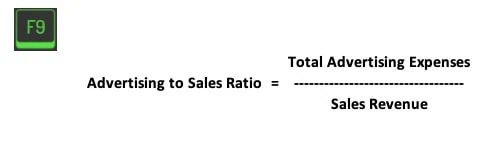
The following items can all be found on a company’s financial statements:
- Total Advertising Expense – All advertising expenses both external (agencies, ads, talent, etc) and internal (marketing and advertising departments)
- Sales Revenue – All revenue that a company generates from selling products or services
Finding Information To Calculate Ratios
If you are working internally for your own company, the financial systems will have all of this information for easy calculations. You may even be able to build these types of ratios right in the system.
To find information externally, you can go straight to the company’s website and look for its SEC filings. You can also use a financial database, like Morningstar, Yahoo! Finance, Seeking Alpha, or Motley Fool.
Let’s Walk Through An Example
First, we need to visit a company’s investor page or access a financial database. For more information on finding investor pages, see our article on Reading Financial Statements.
For this example, we will use McDonalds . This is a great example as they are in an industry with high advertising spend and many of their advertisements are famous. You can find McDonalds SEC filings on their investor website.
We will use the 1Q 2022 filing as this is the most recent available. Here is the income statement which has the information we need.

Many companies will lump all of their advertising expenses in with selling, general, and administrative (S,G,&A). That’s ok, we wont always get the level of detail we need, so we can make an assumption. We will assume for any restaurant in the fast food industry, 50% of S,G,&A is advertising.
Now that we have the data, let’s plug it into our formula.
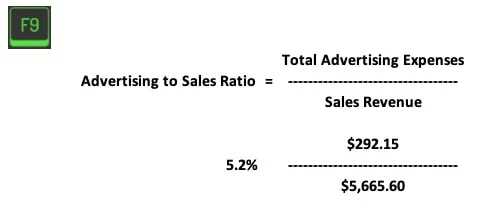
For every $1 in sales, McDonalds only spends $0.05 on advertising. What a low ratio! As such a large and experienced company, they have really fine tuned their advertising.
Let’s Recap
The Advertising to Sales Ratio, or the “A to S” for short, is a measure of how successful a company’s advertising strategies are. A low ratio is good, as it indicates that the advertising campaign generated high sales relative to the amount of money spent on advertising.
Frequently Asked Questions
What Are The Limitations Of The Advertising to Sales Ratio?
One limitation of the Advertising to Sales Ratio is that it does not take into account the time value of money. For example, a company may spend $100 on advertising today and generate $200 in sales six months from now. We would calculate the ratio as 50%, but it does not take into account that the company had to wait.
Another limitation is that the ratio only looks at revenue from sales and does not take into account other sources of income, such as interest or investments.
What Is A Good Advertising to Sales Ratio?
There is no one answer to this question as it will vary depending on the industry, company, and product or service. However, as a general rule of thumb, a low ratio is good. This means that the company is generating high sales relative to the amount of money spent on advertising.
What Is The Difference Between The Advertising to Sales Ratio And The Marketing ROI?
The A to S ratio only looks at revenue from sales and does not take into account other sources of income, such as interest or investments. The Marketing ROI (Return on Investment) takes into account all sources of income and expenses related to marketing, not just advertising.
What are some other ratios that can be used to measure the success of a company’s advertising campaigns?
Some other ratios that can be used to measure the success of a company’s advertising campaigns are the Advertising Cost of Sales Ratio and the Advertising to Total Expenses Ratio.
The Advertising Cost of Sales Ratio measures how much it costs to generate one dollar of sales from advertising. This ratio is useful for comparing the efficiency of two companies’ advertising campaigns.
The Advertising to Total Expenses Ratio measures the percentage of total expenses that are spent on advertising. This ratio is useful for measuring how important advertising is to a company.
Both of these ratios have their own limitations and it is important to consider all factors when evaluating a company’s advertising campaigns.
Have any questions? Are there other topics you would like us to cover? Leave a comment below and let us know! Make sure to subscribe to our Newsletter to receive exclusive financial news right to your inbox.