
Financial Data Quality, and What Bad Data Costs

Having spent years in the trenches of financial analysis, I can tell you firsthand that data quality is the unsung hero of good decision-making. It’s the difference between a forecast that hits the mark and one that misses by miles due to data quality problems.
I remember a project a few years back where we were knee-deep in quarterly projections. Everything was lined up for a stellar presentation to the board, but a last-minute review exposed a glaring error: duplicate entries had inflated our revenue figures.
Panic ensued, presentations were rewritten, and there were a few too many caffeine-fueled nights. That near-disaster taught me a valuable lesson: the devil is indeed in the details, and poor data quality can throw a wrench in the best-laid plans.
The Stakes, What’s Really at Risk
Now, let’s talk about the stakes. Poor data quality isn’t just a matter of embarrassment or a few extra late nights. It has real consequences. Imagine making investment decisions based on faulty data, it’s like building a house on quicksand. The financial repercussions can be enormous, from missed opportunities and wasted resources to regulatory penalties and damaged reputations.
When data quality slips, the ripple effect can be felt throughout the organization, affecting everything from compliance to customer trust. Data consumers rely on high-quality data for analysis and decision-making, making it the one that matters to ensure data quality and accessibility. Simply put, maintaining high data quality is what protects the financial health and integrity of any operation. So, as we dive deeper into the nitty-gritty of financial data quality, keep in mind that this isn’t just about spreadsheets and figures, it’s about creating a solid foundation for informed, strategic decision-making.
Understanding Financial Data Quality
Defining Data Quality in Finance
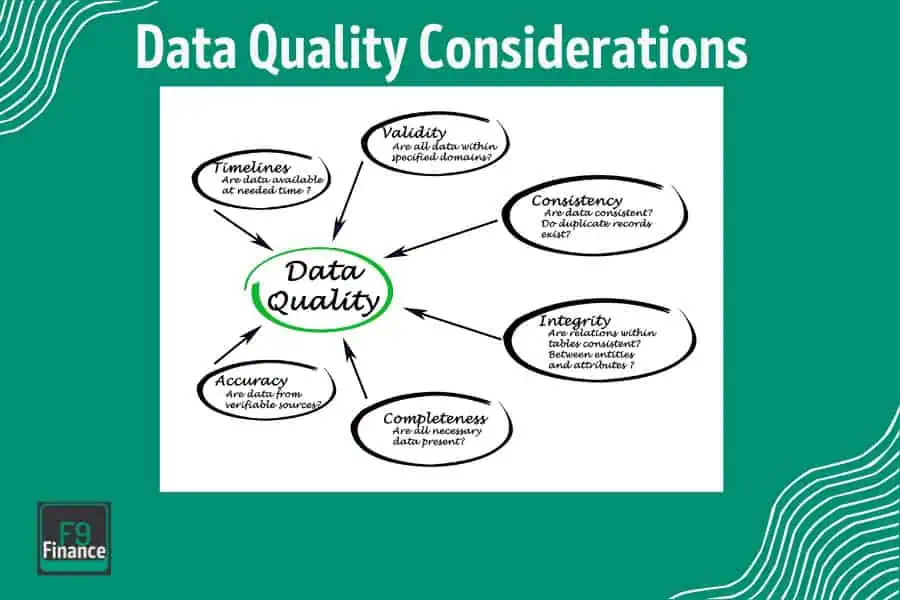
In finance, data quality hinges on four key attributes: accuracy, completeness, consistency, and timeliness.
Accuracy ensures that the numbers reflect reality, a critical factor when you’re making high-stakes financial decisions. Completeness means no missing pieces, so every data point has to be accounted for to provide a full picture. Consistency involves uniformity across data sets so that reports and analyses align without contradiction. Lastly, timeliness ensures that data is up-to-date and relevant, allowing for decisions based on the latest available information. Monitoring these attributes through data quality metrics is essential for identifying trends and areas needing improvement.
I remember one instance where data discrepancies nearly led to a costly error. We were preparing a financial report for a major client, and everything seemed perfect, until we noticed that some figures were misaligned due to inconsistent data entries from different sources. It was a glaring discrepancy that, if left unchecked, could have led to incorrect reporting and a potential breach of trust with the client. This incident was a wake-up call about the importance of vigilance in maintaining data quality.
Why It’s Complicated, The Layers of Data Quality
Managing data quality isn’t just about ticking boxes on a checklist. It’s a multi-layered process that involves navigating complex systems and aligning various data sources. One of the main challenges is the sheer volume of data that organizations deal with today. With information pouring in from multiple channels, ensuring accuracy and consistency becomes a daunting task.
And, financial data isn’t static, it evolves, which means continuous monitoring and updates are the one that matters. Another complexity is the integration of new technologies and data systems, which can sometimes lead to compatibility issues or data silos, where information is trapped in one part of the organization and inaccessible to others who need it.
These layers of complexity require a solid framework for managing data quality, a task easier said than done. Data quality tools are essential instruments that ensure data accuracy, consistency, and reliability, while also helping organizations comply with standards and regulations. It takes the right tools and a culture that treats data integrity as part of the job. It’s a challenging but essential journey, ensuring that financial operations remain reliable and decisions are made on a solid foundation.
Common Issues in Financial Data Quality
Incomplete or Missing Data, The Silent Saboteur
In the whirlwind of financial reporting, incomplete or missing data is like a silent saboteur lurking in the shadows. It often creeps in due to human error, system glitches, or fragmented data collection processes. When pieces of data are missing, it’s like trying to complete a jigsaw puzzle with half the pieces, you’re left with gaps that can distort the big picture.
The implications are serious. Incomplete data can lead to flawed financial reports, skewing results and potentially leading to misguided strategic decisions. Imagine evaluating a potential investment with only half the relevant data, you might end up making a decision based on skewed insights, which could be costly. This issue shows the importance of thorough data validation and checks to ensure that every data point is accounted for.
Inaccurate Data, When Numbers Just Don’t Add Up
Inaccuracy in financial data is a deal-breaker. These inaccuracies often stem from manual data entries, outdated systems, or lack of standardized data protocols, which undermines data consistency. It’s like playing a game of telephone, by the time the message reaches the end, it’s completely different from the original.
When numbers don’t add up, it can lead to incorrect budgeting, forecasting errors, and ultimately, financial losses. For instance, if revenue figures are inflated due to inaccuracies, a company might overspend based on projected profits that don’t exist. Precision is paramount in finance, and ensuring data accuracy is a non-negotiable standard.
Data Duplication, Seeing Double
Duplicate data entries are like seeing double, it can make you question your sanity and the validity of your reports. These duplicates often arise from multiple entries in different systems or lack of integrated data management protocols. Maintaining accurate and comprehensive customer data is the one that matters for ensuring data quality and integration across various applications.
The presence of duplicate data can significantly skew analyses, leading to erroneous conclusions. For example, if a client’s purchase is counted twice, it artificially inflates sales figures, misleading stakeholders about the company’s actual performance. This issue highlights the necessity for a centralized data system that ensures each entry is unique and unrepeatable.
Inconsistent Data, When Information Doesn’t Match Up
Inconsistencies in data are akin to reading conflicting stories in different newspapers about the same event, confusing and unreliable. This issue often occurs when data is pulled from various sources or platforms that don’t communicate effectively.
For instance, if sales data from a retail store doesn’t match the figures in the accounting system, it raises red flags and could indicate deeper systemic issues. Inconsistent data can impact decision-making, which is how people stop trusting the numbers. Ensuring consistency requires solid data integration practices and regular cross-platform audits to ensure all systems are aligned and speaking the same language.
What bad data looks like in practice
F9 Coffee Co. is a seven-store coffee chain I built as demo data for teaching. It is not a real company, and every figure below ships with the dataset so you can check it.
The chain has seven stores and eighteen months of trading, and its point-of-sale export has exactly the problems a real one has.
The data quality checks
The AI library for finance teams
The reconciliation checklist, the join-on-ids rule written out, and the checks that catch the errors validation rules miss. Free, and it lands in your inbox in about a minute.
The same store under fifteen different names
The location column holds fifteen distinct values for seven stores. Seven are correct. Three more are the same names in block capitals, three are in lower case, two carry a trailing space, and 4,999 rows are blank. Group by that column and the report shows fifteen stores, eight of which do not exist.
The store id column is nearly clean, with 24 rows out of 7.29 million missing an id. So the fix is to stop using the name as a key and join on the id, which recovers 4,975 of those 4,999 blank rows and leaves 24 you can see and chase. Cleaning the wrong column is the most common wasted afternoon in this work.
One product, two names, half the sales
A manager at one store renames products at the register, so a single product id appears as both Latte Rg and House Latte (12oz). Group the mix analysis by name and the drink splits into two, and neither half makes the top ten.
Nothing errors. The report runs, the numbers foot, and the answer is wrong in a way no total will reveal.
The rent that got paid twice
In January the Upper West Side rent went out twice, $24,800 on the autopay and $24,800 again when a check cleared. Both entries are correctly recorded. The general ledger and the bank agree with each other perfectly.
The only signal is that ledger rent for that store and month is exactly $24,800 higher than the profit and loss. A precise, explainable difference is the signature of a control failure, and it is what a three-way reconciliation is for.
The one that is off by exactly a thousand
One journal entry has debits of $8,200 against credits of $7,200, so the whole ledger is out of balance by $1,000. It has been that way for months.
A round number is a gift. It tells you the break is one entry rather than an accumulation of rounding, which narrows the search from three thousand lines to one.
The revenue that is not really there
One store roasts beans and sells them to the other six. That internal revenue reaches $395,000 over the period and no elimination has ever been posted, so consolidated revenue is overstated by that amount and the store beats its budget every month.
Every number in that chain was entered correctly. This is the data quality problem no validation rule catches, because it is a question about the business rather than the data.
- Join on ids, not names. Names are entered by people and drift.
- Reconcile in three directions, not two. Bank against ledger against reported.
- Treat a round difference as a single entry, not a rounding issue.
- Ask what the number means, not just whether it validates. The intercompany revenue passes every check you could write.
Step-by-Step Solutions to Improve Data Quality
Step 1: Conducting a Data Quality Assessment
Before diving into solutions, it’s the one that matters to know where the problems lie. Conducting a thorough data quality assessment is like getting a full diagnostic on your car before a road trip.
Start by identifying key data sets and scrutinizing them for errors, look for common culprits like inaccuracies, incompleteness, and inconsistencies. Prioritize these issues based on their impact on your financial operations and decision-making processes. This assessment is the foundation for any remediation efforts, helping you focus on the most critical areas that need immediate attention.
Step 2: Establishing Data Governance
Once the problem areas are clear, it’s time to establish a solid data governance framework. Think of this as setting the rules of the road for your data highway. Begin by defining roles and responsibilities, who owns the data, who can access it, and who is responsible for maintaining its quality.
This framework acts as a guardian, maintaining the integrity and reliability of your data over time.
Step 3: Implementing Data Cleaning Processes
With governance in place, roll up your sleeves and start cleaning!
Data cleaning involves scrubbing your datasets to remove errors and standardize information. Use techniques like deduplication to eliminate double entries and validation checks to ensure data accuracy. Standardization processes help align data formats, making it easier to merge information from different sources. These cleaning processes are essential for transforming raw, messy data into a polished, reliable asset for your organization.
Step 4: Continuous Monitoring and Improvement
Data quality is not a one-and-done task. It needs watching. Set up systems for continuous monitoring to catch and address issues as they arise. Implement automated tools that can alert you to anomalies and discrepancies in real-time. Regular audits and reviews can help ensure that your data governance policies are being followed and that your data remains accurate, complete, and consistent. This commitment to continuous improvement ensures that your data quality keeps pace with the evolving needs of your business.
Tools and Technologies for Data Quality Management
Overview of Popular Tools
Navigating the sea of data quality management can feel overwhelming, but luckily, there are some trusty tools that can steer you in the right direction. Let’s get into a few of the leading solutions designed to keep your data ship shape:
- Talend Data Quality: Talend is like your Swiss army knife for data quality management.
- Informatica Data Quality: Renowned for its solid data profiling and cleansing capabilities, Informatica ensures your data remains accurate and consistent. It’s particularly praised for its integration features, which allow clean data management across platforms.
- IBM InfoSphere QualityStage: If you’re dealing with large volumes of data, IBM’s tool is designed to handle the heavy lifting. It excels in data standardization and matching, helping you maintain a clean and reliable database.
- SAP Data Services: Offering strong data integration and cleansing features, SAP Data Services is a favorite among enterprises aiming for high-quality, actionable insights. Its ability to handle complex data transformations makes it a solid choice for businesses of all sizes.
These tools are your allies in the quest for pristine data, each bringing its unique strengths to the table.
How Technology Can Help, Data Quality in the Age of AI
Now, let’s talk about the game-changer: artificial intelligence. In the age of AI, data quality management is getting a serious upgrade. Machine learning algorithms can sift through oceans of data, spotting patterns humans might miss and flagging inconsistencies faster than you can say “data discrepancy.
By learning from past data interactions, AI systems can predict and prevent future errors, ensuring your data remains reliable.
AI doesn’t just keep your data clean, it makes it smarter, enabling a level of precision and speed that was previously unattainable.
In short, embracing AI and machine learning in data quality management is like having an assistant that never stops checking. It is about making sure your data is always ready to support your strategic goals.


